You made it through the day. Lunches packed, school drop done, work handled, dinner on the table. Then someone spills a drink at 7pm and something in you snaps. You hear your own voice and do not recognize it. After the kids are in bed you sit with the guilt, wondering when you stopped feeling like a parent and started feeling like someone just trying to survive until Friday. That feeling is not a character flaw. It is what happens when the demands on you outpace what you have left to give. And it happens to far more parents than you might think.
What this looks like in real life
Parenting stress anxiety does not always announce itself. It builds in the space between everything you are supposed to do and everything you actually have left. You notice it in how you speak before you have even had breakfast. Or in how your shoulders never fully come down, even on a quiet evening.
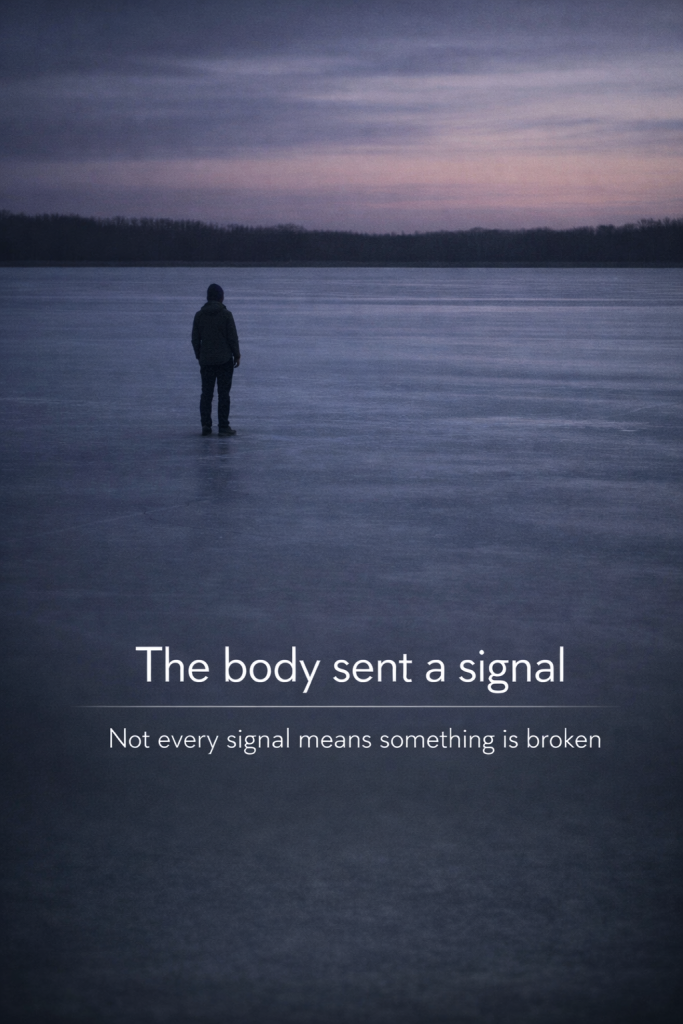
Being overwhelmed by parenthood can feel different from what you expected. You thought you would feel tired. You did not expect to feel hollow, reactive, and then guilty about the reactive part. That cycle alone is exhausting.
Some parents feel it as physical tension. A tight jaw. Shortened breath. A constant readiness for the next problem that never fully switches off. Others feel it as emotional flatness. Present in the room but barely there. Going through the motions because the motions still have to happen.
There is also the invisible weight of the mental load. Who needs to be where. What is almost out of the fridge. Which kid has the appointment. None of that turns off at night. It runs quietly in the background until your brain is too tired to think clearly about anything.
This is not a parenting failure. This is a human system under sustained pressure with very few real breaks.
Why it sticks and what helps
Parenting rarely has a natural stopping point. There is no end of the workday that actually holds. Even when the kids are asleep, the mental load hums on. Your system stays alert because alert is how you have been getting through.
Asking for help can also feel complicated. Some parents worry it signals they are not coping. Others do not know what help would even look like. So they keep going, adding better systems, setting earlier alarms, trying to get ahead of a list that keeps growing.
Guilt makes it stickier. Guilt about yelling. Guilt about screen time. Guilt about wishing for more time alone. Guilt keeps you focused on what went wrong instead of what you actually need.
Using national data as Minnesota specific research unavailable.
Research consistently links high parenting stress with increased anxiety, depression, and physical health strain in parents. Studies also show that stressed parents tend to be more reactive and less available for the warm connection kids need most. Understanding the cause can take some of the shame out of the experience. You are not struggling because you do not love your kids. You are struggling because the load is genuinely heavy.
Even small reductions in daily pressure can shift things. You do not need a different life. You need a few things to ease, and a plan for making that happen.
Minnesota factors to consider
Minneapolis parents often carry a pace that does not slow down until the weekend, and sometimes not even then. The workday ends but the parenting shift does not. Many families are managing it all with little backup nearby, which means the weight stays concentrated on a small number of people.
In the Twin Cities broadly, dual incomes are common and expectations are high. Work does not pause because a child is sick or a night was hard. That combination leaves many parents running a deficit they never fully recover from during the week.
St Paul families face the same pressures. Winter brings short days and cold that make getting outside feel like one more task. Hockey season often adds early mornings and late drives on top of an already full week. That rhythm is part of what Minnesota families love about their lives and also part of why some stretches feel relentless.
Workplaces like General Mills reflect a broader culture of performance. Many parents carry professional expectations that do not soften just because things are hard at home.
NAMI Minnesota offers community programs and education that can reduce isolation for parents who have been carrying too much in silence. Knowing that local support exists is often the first step toward using it.
A composite example of change
This is a composite example and details are changed for privacy.
A parent of two in the Minneapolis area described feeling like a survival mode parent for most of the previous year. They were getting through the days but rarely felt present in them. Evenings were the hardest. The kids needed the most from them exactly when they had the least to give.
The yelling at my kids guilt was what they struggled with most. Not dramatic blowups. Just a sharp tone that arrived before they could catch it. After each moment they would replay it, promise to do better, and then find the same thing happening again the next evening.
What shifted was not a dramatic change in circumstances. It was getting honest about how depleted they were and starting to treat that depletion as real. They built one short daily reset. They began asking their partner for one specific thing each week that would actually help.
The mom burnout did not disappear overnight. But the guilt started to loosen once they understood what was driving the reactivity. That understanding made the next small step easier.
Practical steps you can start this week
Survival mode does not end all at once. It eases when you start protecting small pockets of recovery. None of the steps below require a perfect day or extra time you do not have.
- Name what is draining you most right now. Be specific. Vague exhaustion is harder to address than a concrete problem.
- Choose one task you can drop, delay, or hand off this week without it becoming a crisis.
- Build one short transition between work and parenting. A walk, a change of clothes, three slow breaths in the car before you go inside.
- Learn your warning signs before you snap. A tight chest, a shorter tone, a faster pace. Name the signal so you can use it.
- Make one direct request to your partner or someone in your support circle this week. Not a hint. A clear ask.
- Protect one small piece of time that is yours. Even twenty minutes where you are not available counts.
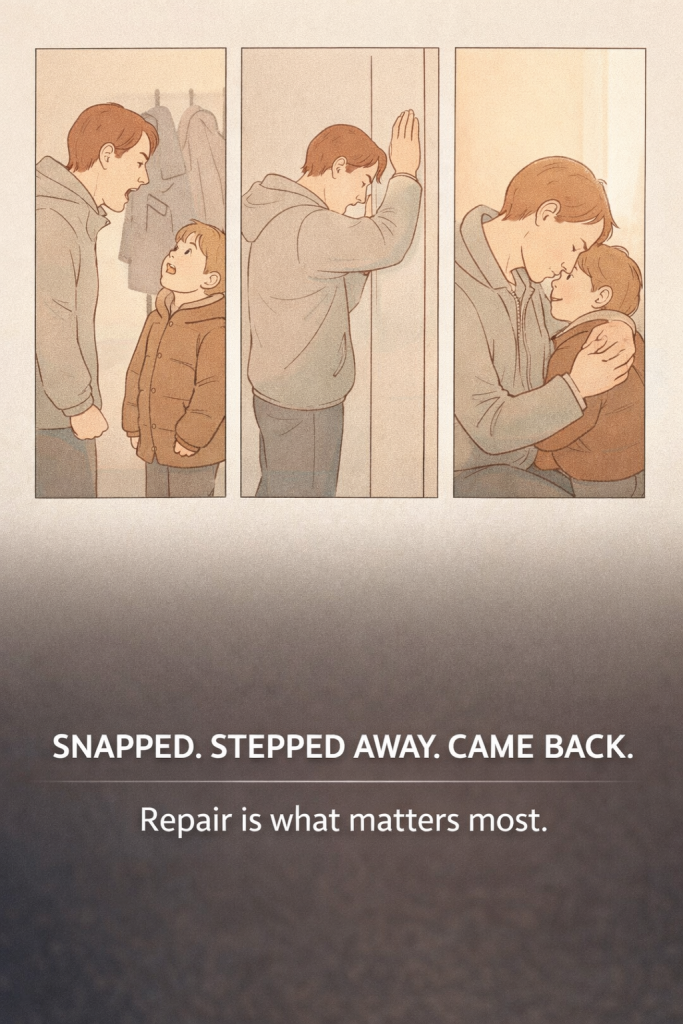
- When guilt shows up after a hard moment, practice one reset instead of a long spiral. Apologize if it fits, then move forward.
- Reduce one low-value obligation that does not need to be yours right now.
- Track one thing that went well each day. Not to dismiss the hard parts. To remind your brain the whole story is not only bad.
If the pressure is also showing up in your relationship, having a shared plan for reconnecting after hard nights matters. You can read more about how conflict repair works when you are both running on empty and what makes those moments actually land.
FAQ
Is it normal to resent my kids sometimes?
Yes. Resentment usually points to a need that is not being met, not to a problem with how much you love your children. When you are chronically depleted, resentment can show up quickly. It is worth taking seriously as information, not as evidence of failure.
What is the difference between parenting stress and burnout?
Stress tends to feel like too much pressure. Burnout tends to feel like nothing is left. If you are exhausted even after rest, emotionally flat, and going through the motions without any sense of reward, burnout is worth addressing directly.
How do I stop snapping at my kids?
The goal is catching the warning signs earlier. When you recognize your physical signals before the snap, you have a moment to pause. A short break or a simple statement like “I need one minute” can change what happens next.
Can therapy help overwhelmed parents?
Yes. Therapy can help you understand what is driving the depletion, build practical tools for the hardest moments, and work through the guilt that tends to pile up when parenting feels this hard.
How do I know when I need more than an article?
If you are consistently irritable, sleep is suffering, you feel hopeless about things improving, or your relationships are strained, those are clear signals that more support would help.
You are not failing at parenting. You are doing a very big job with a finite amount of energy and very few real breaks. That is not a character flaw. It is a situation that can change with the right support.
The hardest part for many parents is giving themselves permission to need something. But you cannot stay steady for your kids when your own system is running on empty.
If this resonates, it may be time to talk with someone who can help you sort out what needs to shift. Support is not a last resort. For a lot of parents, it is what finally makes the days feel manageable.
Many parents wait until things are very hard before reaching out. If you are noticing the signs now, that is a good reason to take a step sooner rather than later.
Get Support: Meet Mitch: Meet Mitch (612) 562 9880 Schedule: Schedule a consultation
Sources:
US Surgeon General’s Advisory on Parental Mental Health (2024): https://www.ncbi.nlm.nih.gov/books/NBK606662/ Jornal de Pediatria, Parental Stress and Offspring Meta-Analysis (2024): https://www.sciencedirect.com/science/article/pii/S0021755724000408 Clinical Child and Family Psychology Review, Parental Stress and Well-Being Meta-Analysis (2025): https://link.springer.com/article/10.1007/s10567-025-00515-9