Most people do not set out to spend their evening scrolling through heavy headlines. It starts as a quick check while dinner is in the oven or while you are waiting for your kid at practice. Then your chest feels tighter. Your mind starts rehearsing worst case scenarios. You keep scrolling because it feels like staying informed will make you safer, but you end up more wired and less steady. If that sounds familiar, you are not broken. Your brain is doing what it was designed to do in the face of uncertainty. The good news is you can stay informed without living in a constant state of alarm, even in the middle of winter in Minnesota.
When staying informed starts to feel like a threat
There is a difference between reading the news and living inside it.
When news becomes constant, your nervous system can treat every update like a new danger. You might notice irritability, trouble sleeping, a short fuse with your partner, or a feeling that you cannot fully relax. People often describe it as being on alert even when nothing is happening in their living room.
This is where news fatigue shows up. You still care, but your body is tired. You might bounce between compulsive checking and total avoidance. Both are understandable, and both can leave you feeling stuck.
A big driver is doomscrolling. When you keep consuming stressful content past the point where it is useful, your brain does not get the signal that the threat has passed. It is like tapping the gas pedal while your foot is also on the brake. You get more activated, but you do not go anywhere.
If you have a history of anxiety, trauma, or chronic stress, the effect can feel stronger. Even people who normally manage life well can start noticing headaches, stomach tension, and a constant mental replay loop.
The goal is not to pretend the world is fine. The goal is to protect your capacity to live your life, care for your people, and make clear choices.
Minnesota context: why it can feel extra intense right now
Minnesota life has a steadying rhythm, but winter can amplify stress. Short days, icy roads, and long stretches indoors make it easier for worry to grow. January in particular can feel like a pressure cooker, especially when you are trying to juggle work, family, and a packed calendar.
In the Twin Cities, people often hold a lot. Commutes through Minneapolis or St Paul traffic. Kids activities in Maple Grove or Minnetonka. Aging parents. Work deadlines. When you add constant notifications, your brain rarely gets a true off switch.
Local media matters too. Many Minnesotans rely on outlets like MPR News and the Star Tribune for community updates, weather shifts, school closings, and big stories that affect daily life. Those sources can be helpful, but the always on access can also make the nervous system feel like it has to monitor everything.
Using national data as Minnesota specific research unavailable.
If you work at a high pace company like Target or in a high demand role like health care, education, or public service, you might already be carrying stress before you open your phone. Add in social media feeds that reward outrage and urgency, and it is easy to feel flooded.
The solution is not to disconnect from your community. It is to choose a healthier way to engage so you stay grounded enough to do what matters to you.
What research suggests about constant negative news
Your brain is built to spot threats quickly. That bias helped humans survive. In modern life, it can make negative headlines feel more important than they actually are for your immediate safety.
Research on doomscrolling suggests it can be linked with worse well being and higher anxiety. Some studies connect it with existential anxiety, which is that deep sense of dread that can show up when the world feels unpredictable. When you consume a steady stream of alarming stories, your mind can start treating uncertainty as the default.
Other research on media induced uncertainty suggests that repeated exposure to distressing information can increase stress and emotional strain. Even when the events are not happening directly to you, the body can still react as if it needs to prepare.
This does not mean you should never read the news. It means you should treat your attention like a limited resource. You can be informed in a way that supports mental health instead of eroding it.
A composite Minnesota example of how the cycle plays out
This is a composite example with details changed for privacy.
A Minnesota parent in Rochester noticed a pattern: every night after the kids went to bed, they would check the news to feel caught up. Ten minutes turned into an hour. Their heart would race. They would start scanning for more updates, then switch to social media to see what other people were saying. Sleep got lighter. Mornings felt tense. At work, they had a harder time concentrating.
They told themselves they needed to know what was going on. Under that belief was a quieter fear: “If I miss something, I will be unprepared.”
What helped was not forcing themselves to stop caring. What helped was building a plan and practicing it with consistency. They chose a short window to read updates, switched off alerts, and added a calming routine afterward so their body learned how to settle. Over a few weeks, their sleep improved and the evening anxiety eased.
If you have been hoping a stronger willpower muscle will fix this, you are not alone. The better approach is structure plus self compassion.
Practical steps that reduce anxiety without checking out
You do not need a perfect plan. You need a repeatable one. The point is to help your nervous system feel safe again while you stay connected to real life.
-
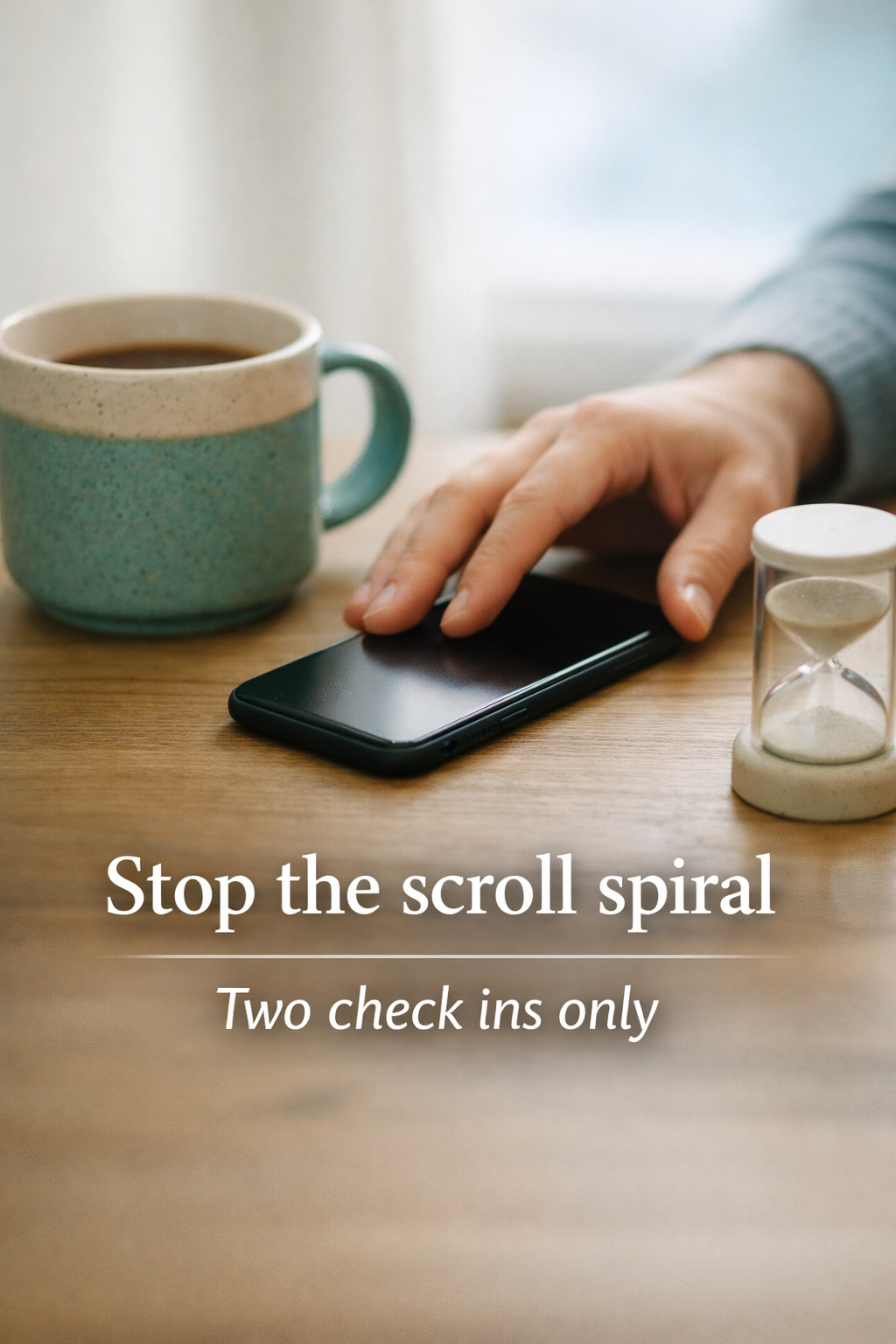
Pick two check in times and stick to them
Choose a morning slot and an early evening slot. Keep each one short, like ten minutes. -
Turn off breaking news notifications
Alerts are designed to interrupt you. Removing them is a direct way to reduce your baseline stress. -
Choose one trusted source for headlines
Limit your starting point to one outlet you respect. This reduces rabbit holes and rumor loops. -
Use a transition ritual after reading
Wash dishes, take a shower, stretch, or walk the dog. This teaches your body that you can return to calm. -
Practice the three breath reset
Inhale slowly, exhale longer than you inhale, repeat three times. These are simple stress management tools that work best with repetition. -
Use the question “What action can I take today?”
If the answer is none, stop. If there is an action, write it down and do it once. -
Replace doomscrolling with one grounding cue
Hold a warm mug, feel your feet, look out the window at the snow, name five things you see. This interrupts the alarm loop. -
Add one connection point each day
Text a friend, chat with a neighbor, or plan a small weekend activity. Social connection counters threat based thinking. -
Get support if the stress is sticking around
If this pattern keeps returning, anxiety therapy in Minnesota can help you build a plan that fits your life and your nervous system.
FAQ
Is it normal to feel anxious after reading the news?
Yes. Your brain reacts to uncertainty and threat cues. If the anxiety is frequent or impacts sleep, a plan can help.
How do I stop checking my phone without feeling guilty?
Start by limiting, not banning. You can care and still protect your attention.
What is the difference between staying informed and being flooded?
Staying informed leads to clarity and action. Being flooded leaves you tense, scattered, and stuck in worry loops.
Can doomscrolling become a habit?
Yes. It can become a stress habit where checking temporarily reduces uncertainty, then increases anxiety long term.
Should I avoid the news completely?
Not necessarily. Many people do better with boundaries, trusted sources, and short check in windows.
When should I consider therapy for this?
If you feel stuck, sleep is disrupted, relationships are strained, or anxiety spreads into other areas, support can help.
What should I look for in a Twin Cities therapist?
Look for someone who helps you build practical boundaries, supports nervous system regulation, and fits your values and communication style. A Twin Cities therapist should also understand local stressors and daily life in Minnesota.
If you have been feeling on edge, you are not alone. You can care about what is happening and still protect your mind. The goal is to stay connected to your life, your values, and the people right in front of you. Small boundaries add up quickly when you practice them consistently. If you want support building a plan that fits your routine, anxiety therapy in Minnesota can be a steady place to start. You deserve a nervous system that can rest.
Get Support:
Meet Mitch: Meet Mitch (612) 562-9880
Schedule: Schedule a consultation
Sources:
-
When the news is too much, find solace in these 10 local spaces (Star Tribune, 2026): https://www.startribune.com/best-ways-places-chill-out-calm-fun-recharge-minneapolis-st-paul-twin-cities/601561122
-
Doomscrolling dangers (Harvard Health Publishing, 2024): https://www.health.harvard.edu/mind-and-mood/doomscrolling-dangers
-
Impact of Media Induced Uncertainty on Mental Health (JMIR Mental Health, 2025): https://mental.jmir.org/2025/1/e68640/